Use this as a quick reference for the continuity equation, Bernoulli's equation, Torricelli's theorem, and the ideal-fluid assumptions behind all three.
🧭 Plot Summary
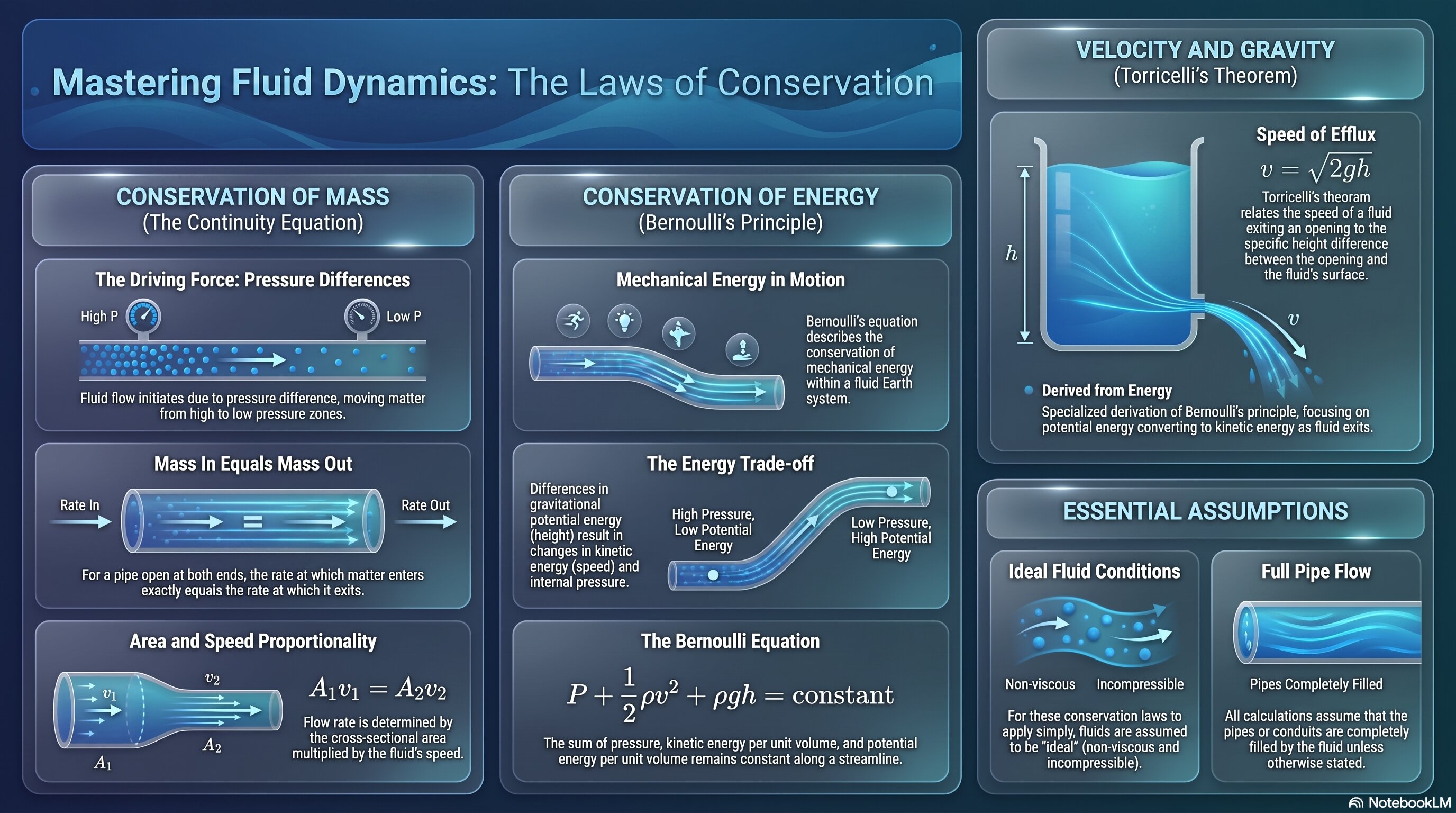
Unit 8 closes with the same two conservation laws that have run through this entire course — conservation of mass and conservation of energy — applied to fluid flow. A difference in pressure between two locations is what actually gets a fluid moving in the first place. Once it's moving, mass conservation says the rate of matter entering a tube must equal the rate exiting it, which leads directly to the continuity equation: A₁v₁ = A₂v₂ — narrower pipe, faster flow.
Energy conservation leads to Bernoulli's equation: P + ½ρv² + ρgh = constant along a streamline. Pressure, kinetic energy per volume, and potential energy per volume trade off against each other, but their sum never changes. A special case of that trade-off — fluid draining out of an opening in a tank — gives you Torricelli's theorem, v = √(2gh), which isn't a new law at all, just Bernoulli's equation applied to one specific situation.
Two conservation laws, one unit
What you will do in this lesson
- Explain that fluid flow is driven by a pressure difference between two locations.
- Apply mass conservation: the rate of matter entering a tube equals the rate exiting it.
- Apply the continuity equation A₁v₁ = A₂v₂ to relate cross-sectional area and fluid speed.
- Apply Bernoulli's equation, P + ½ρv² + ρgh = constant, along a streamline.
- Apply Torricelli's theorem, v = √(2gh), derived directly from conservation of energy.
- Identify the ideal-fluid and full-pipe assumptions underlying these laws.
Why it matters
This is the capstone of the entire course — the same conservation principles from Units 2 through 4, applied one more time to a system that flows instead of just moving. It's also a reminder that these equations only apply under specific conditions: an ideal (non-viscous, incompressible) fluid, in pipes assumed completely filled, unless a problem tells you otherwise.
✅ Self-Check Before You Roll On
Check off each item as you get there. These are not grades — they are your own signal.