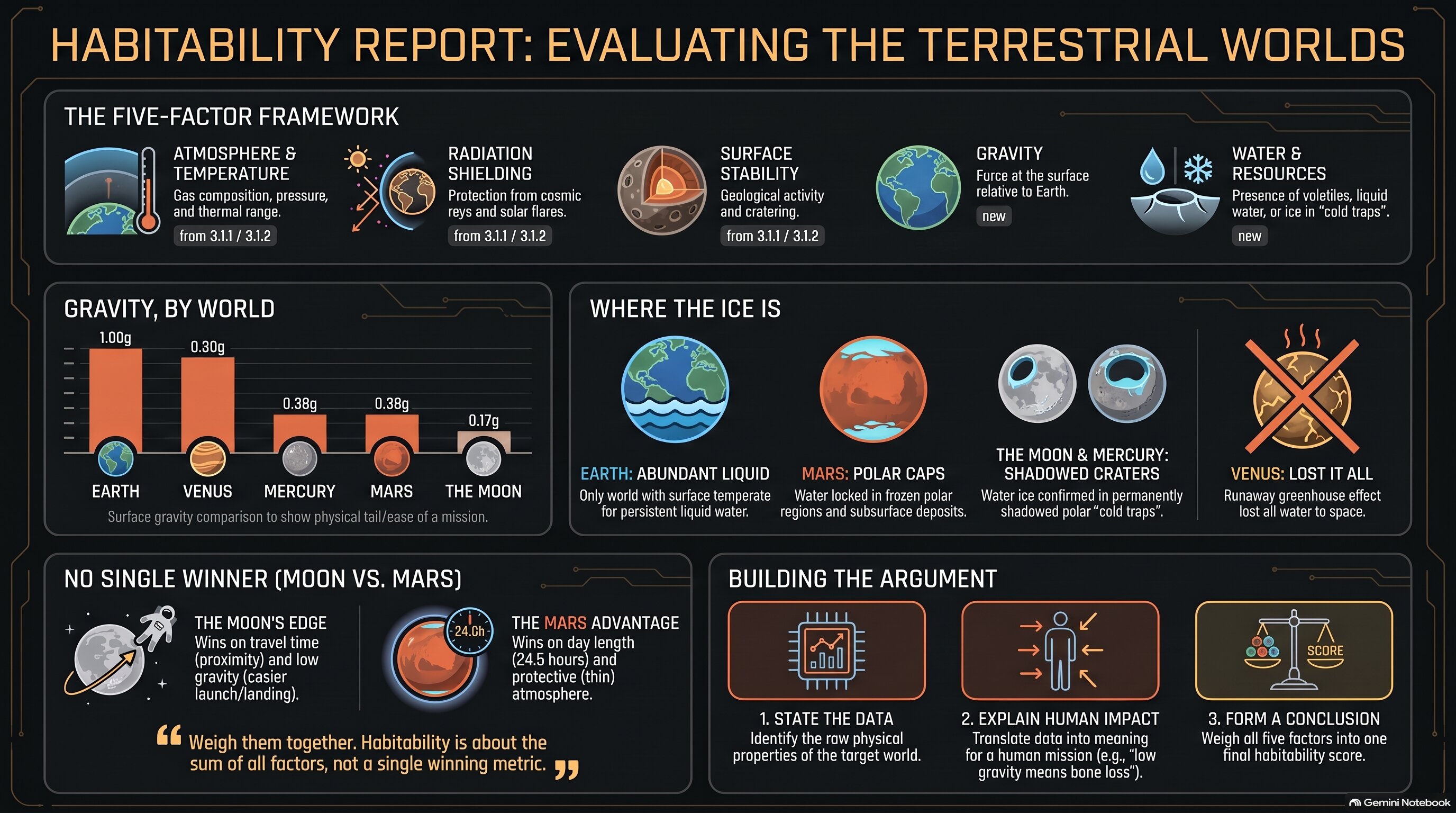
Quick reference for the five-factor habitability framework.
🧭 Plot Summary
Activities 3.1.1 and 3.1.2 gave you most of what you need — atmosphere, temperature, magnetic fields, and a world's geological history. This project adds the last two pieces that turn "interesting planet" into "candidate for human exploration": surface gravity, which matters directly for a human body, and where water and ice actually turn up — sometimes in places you wouldn't expect. Put all five factors together, and you can build a real, defensible argument for which of two worlds is the better bet.
What you'll do in this project
- Meet the five-factor framework mission planners actually use to size up a world's potential.
- Add two new numbers to your toolkit — surface gravity and day length — and see why both matter for real humans.
- Track down water and ice in some surprising places, including two airless worlds you might not expect.
- Practice weighing several factors together, since no world wins on every single one.
- Build your own two-world comparison, citing real data instead of a gut feeling.
Why it matters
This is the last stop before Unit 3 turns outward to the gas giants and small bodies. It's also your first full dry run at the kind of evidence-based argument the unit's final problem, Where Do We Send It?, will ask you to make for real.
✅ Self-Check Before You Roll On
Check off each item as you get there. These aren't grades — they're your own signal.