Quick reference for scale factors, and why real scale models end up enormous.
📏 Plot Summary
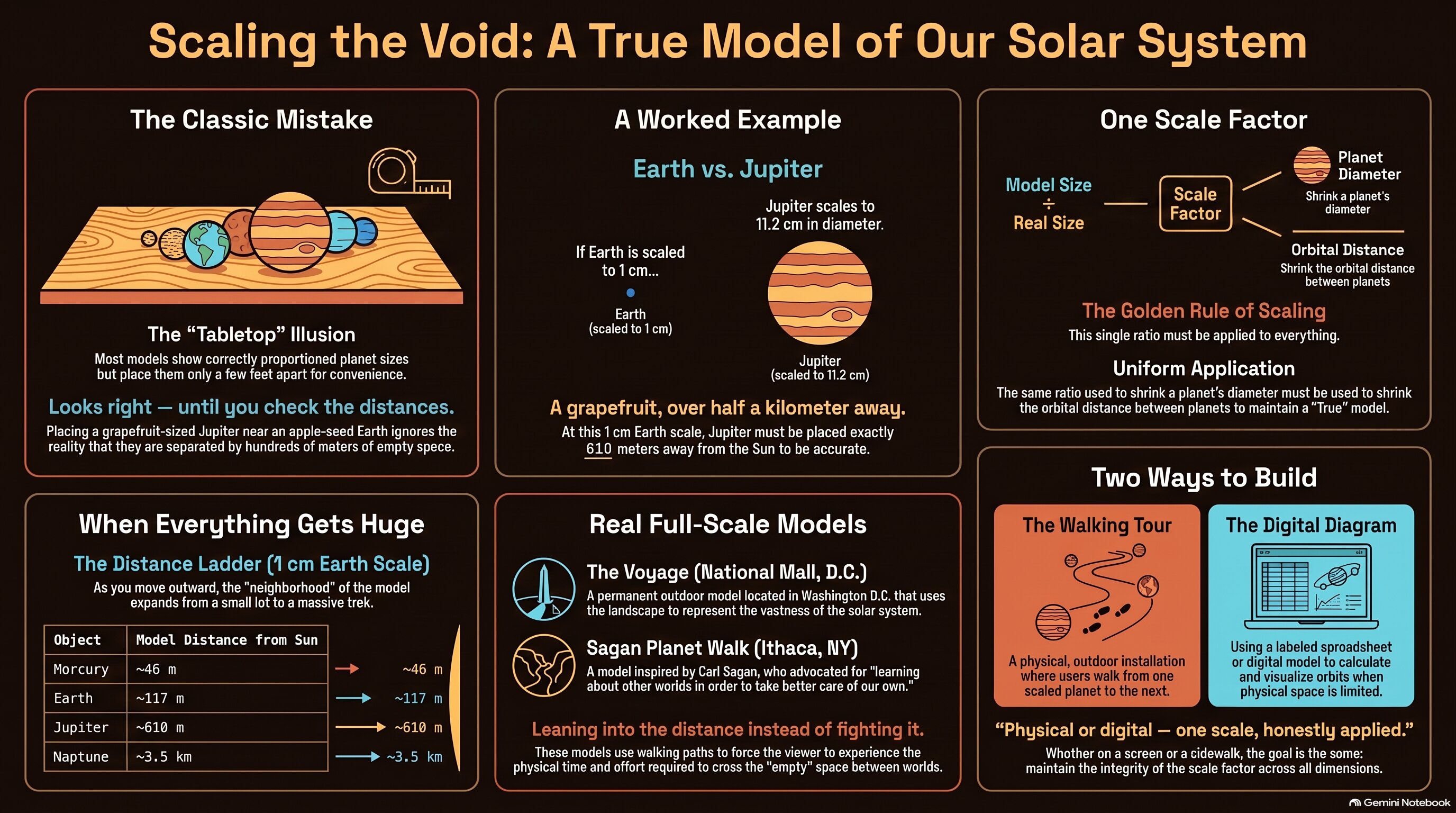
Almost every homemade solar system model makes the same mistake: planets sized to look reasonable, spaced a few feet apart to fit on a table — and both numbers can't be honest at once. Once you commit to a single, consistent scale, the distances stop being polite. Shrink Earth down to the size of a pea and the Sun down to a beach ball roughly a meter wide, and that tiny Earth still ends up about 120 meters away — with Neptune more than three kilometers out. You'll learn exactly why that happens, then build your own model — physical or digital — that's honest about both numbers at once, and document the scale you used well enough that anyone could check your math.
What you'll do in this project
- Meet the classic mistake: a model where the planets look right but the distances are wildly, hilariously wrong.
- Learn to pick one scale factor and apply it consistently to both size and distance.
- Watch what happens to real distances once you scale the planets down to something you could actually hold.
- See how real full-scale models solve this problem — by taking up an entire park, or a whole city block.
- Build your own model, and write up the exact scale you used and why.
Why it matters
Problem 3.3.1, Where Do We Send It?, closes out this unit with a real mission proposal — and no mission plan makes sense without an honest sense of just how far apart everything in the solar system actually is.
✅ Self-Check Before You Roll On
Check off each item as you get there. These aren't grades — they're your own signal.