Quick reference for the milestones of cosmic history and the ways to fit them on one page.
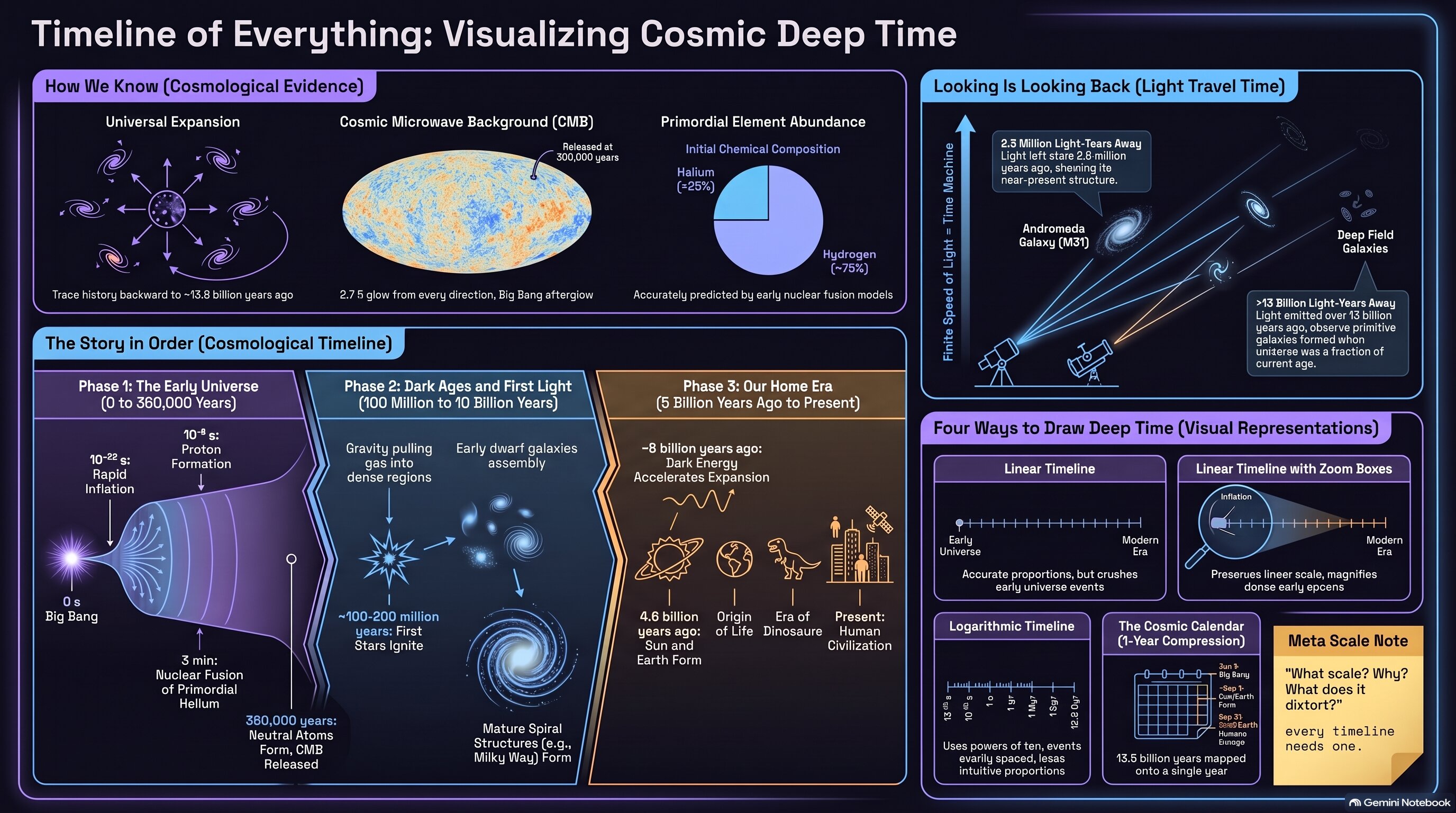
⏳ Plot Summary
The universe is about 13.8 billion years old, and you're going to fit all of it on one page. First, you'll learn the part of the story this course hasn't told yet: how we know the Big Banghappened, and what happened in the first minutes, the first 380,000 years, and the long cosmic dark ages before the first stars switched on. Then you'll build a timeline or infographic of cosmic history. The hard part isn't the facts — it's the design. Draw it to true scale and the first 380,000 years vanish into a single point, while all of human history fits in the width of a hair. Solving that problem honestly is the project.
What you'll do in this project
- Learn how we know the Big Bang happened — including the leftover glow still arriving from every direction.
- Follow the story from the first split second, through the cosmic dark ages and the first stars, to the Sun, Earth, and you.
- Wrestle with the real design problem: most of the action happens in the first few minutes, and humans show up in the last blink.
- Pick a scale — true-to-proportion with zoom boxes, logarithmic, or a cosmic calendar — and defend it.
- Build a timeline or infographic of everything, Big Bang to today, with the evidence behind each milestone.
Why it matters
This timeline ties the whole unit together — the expansion from 5.2.1, dark matter and dark energy from 5.2.2, and the galaxies from 5.1.1 and 5.1.2 all have a place on it. It's also the backdrop for Unit 6: the universe has to be old enough, and rich enough in heavy elements, for planets and life.
✅ Self-Check Before You Roll On
Check off each item as you get there. These aren't grades — they're your own signal.