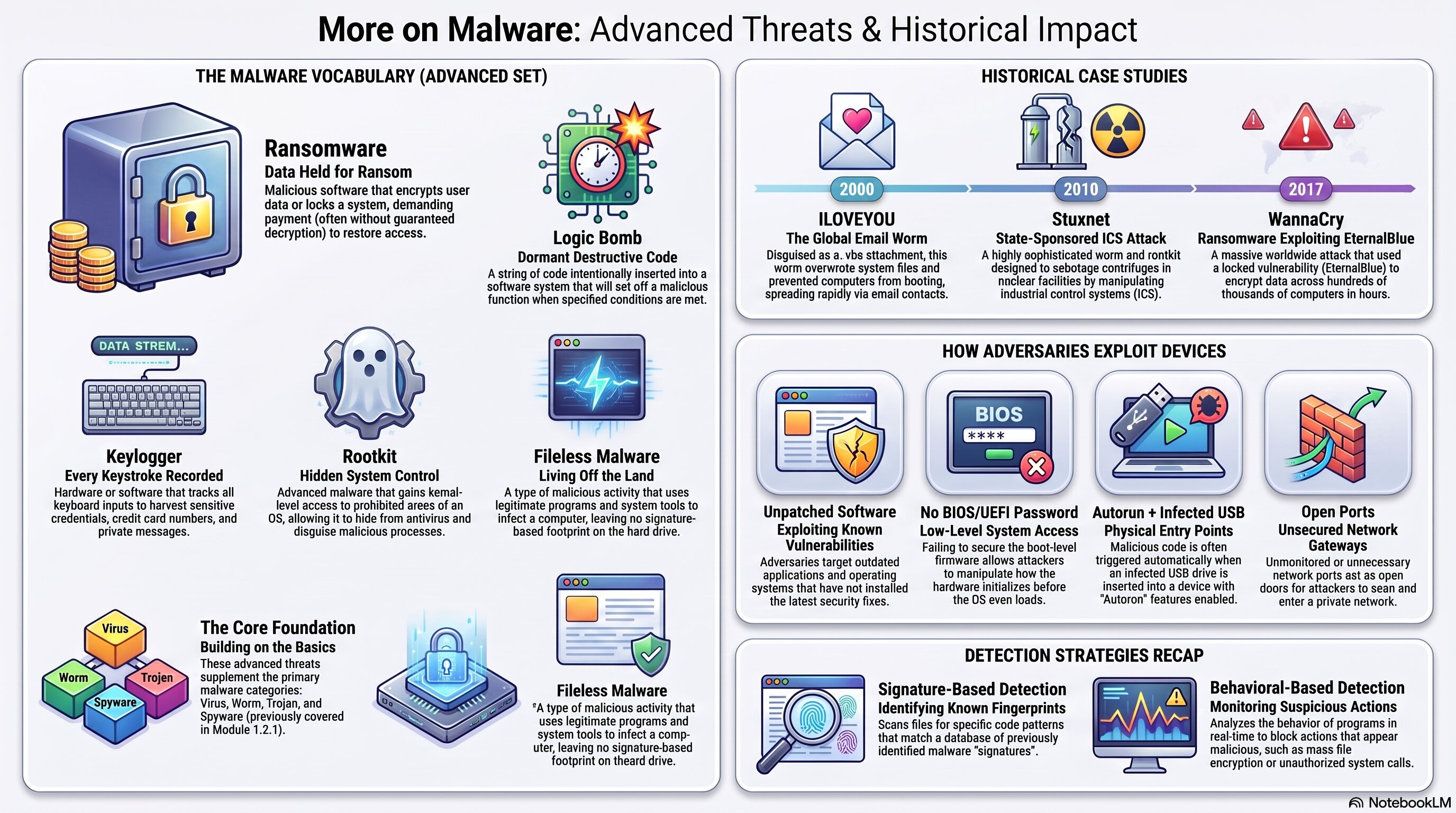
Use this as a quick reference for the full malware vocabulary, device vulnerability exploitation, and the three historical attacks.
🧭 Plot Summary
Back in 1.2.1, you deliberately learned only five malware types — virus, worm, trojan horse, backdoor, and spyware. This activity finishes the vocabulary with five more, several of which are far more dangerous than anything you've studied so far:
Ransomware
Encrypts files, demands payment for the key
Keylogger
Records keystrokes, steals credentials
Logic Bomb
Triggers only when specific conditions are met
Rootkit
Controls the OS, hides itself from detection
You'll also meet fileless malware — code that lives in memory instead of on disk — and study three real attacks that show these concepts weren't invented for a textbook: ILOVEYOU (2000), Stuxnet (2010), and WannaCry (2017).
What you will do in this lesson
Expand your malware vocabulary with five new types: ransomware, keylogger, logic bomb, rootkit, and fileless malware.
Study three real, historical malware attacks: ILOVEYOU, Stuxnet, and WannaCry.
Learn how adversaries exploit device vulnerabilities beyond malware alone — unpatched software, BIOS/UEFI, autorun, and open ports.
Revisit anti-malware detection methods now that you have the full vocabulary.
Why it matters
These three historical attacks show up constantly as multiple-choice context clues — knowing the type and mechanism of each, cold, is high point-value for very little study time.
✅ Self-Check Before You Roll On
Check off each item as you get there. These are not grades — they are your own signal.